

The Liberal administration has introduced comprehensive new legislation aimed at safeguarding victims and survivors of sexual and intimate partner violence, as well as shielding children from predators.
Describing the Protecting Victims Act as “one of the most significant reforms of the Criminal Code in a generation,” the proposed law also contests a 2016 Supreme Court decision that permits cases to be postponed if they are excessively delayed.
Additionally, the legislation seeks to enhance penalties for sexual offenses, including the distribution of intimate images, sexual deepfakes, and the procurement of sexual services from minors.
“With the introduction of the Protecting Victims Act today, we have a chance to better safeguard children at risk of exploitation and to tackle pressing issues surrounding violence against women, including potentially lethal violence,” stated Justice Minister Sean Fraser during an announcement in Ottawa on Tuesday.
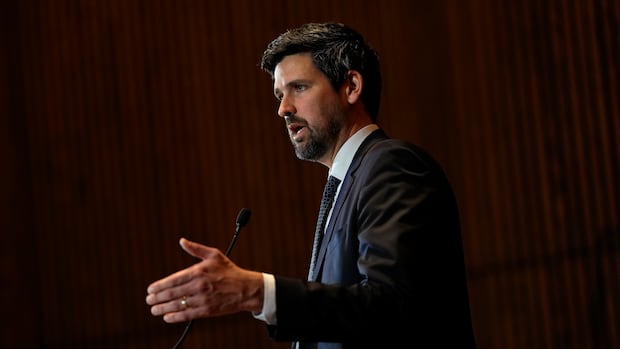
Justice Minister Sean Fraser announced the Protecting Victims Act on Tuesday which aims to protect children and survivors of sexual and intimate partner violence. The bill includes tougher penalties for sexual offenses such as distributing intimate images and sexual deepfakes.
This proposed legislation reinstates mandatory minimum sentences that have been ruled unconstitutional by the Supreme Court of Canada and various provincial courts, which determined that these sentences infringe upon Section 12 of the Charter by subjecting offenders to cruel and unusual punishment.
Sources familiar with the matter indicated that mandatory minimum sentences have historically breached Section 12 due to a judicial test known as reasonable hypothetical scenario. This test has led courts to assert that lacking the discretion to impose lesser sentences in rare hypothetical cases is unconstitutional. Officials believe that by granting courts limited discretion, mandatory minimum sentences will withstand constitutional scrutiny in the future.
-
Carney announces sweeping plan to crack down on crime, strengthen the border
-
Justice system betrays sexual violence survivors, says federal advocate for victims of crime
-
Poilievre says he’d invoke notwithstanding clause to overturn ruling on child porn sentences
Under the Protecting Victims Act, judges would retain the authority to impose lighter sentences when a conviction results in imprisonment, though incarceration would still be mandated. In cases of murder or treason, where life imprisonment is the sentence, lesser sentences would not be allowed.
Should the bill be enacted, it would reinstate all mandatory minimum sentences that have been invalidated by the courts but still exist in legislation. Mandatory minimums that Parliament has already repealed would not be reinstated.
Safeguarding children online
Bill C-16 aims to reinstate at least a dozen mandatory minimum penalties for offenders convicted of various sexual crimes against children, including the possession or access of child sexual abuse and exploitation materials.
These amendments follow a ruling in October by the Supreme Court of Canada, which found that a one-year mandatory minimum sentence was unconstitutional for two men who admitted guilt for possessing hundreds of images of child abuse.
“Many occasions exist where the Supreme Court of Canada has invalidated similar penalties within the Criminal Code,” Fraser remarked regarding the October ruling.
“We are advancing with a plan that will not only restore those penalties that have been annulled, but will also protect the remaining mandatory minimums that have yet to be invalidated but remain constitutionally at risk.”
Bill C-16 further commits to addressing sextortion and the online luring of children by criminalizing even the threat of distributing child abuse or intimate images.
Other suggested modifications would simplify the prosecution of offenders who sexually exploit children internationally, and focus on criminal groups that entice or groom minors to commit crimes on their behalf.
Addressing intimate partner violence and femicide
The proposed legislation confronts intimate partner violence by categorizing hate-motivated murder as a first-degree offense, even if it was not premeditated.
Femicide cases, defined as the murder of a woman or girl, would also be classified as first-degree murder, regardless of premeditation, provided it can be demonstrated that the victims endured a pattern of abuse or coercive control.

Following the announcement of new legislation aimed at protecting victims of intimate partner violence and sexual assault, Justice Minister Sean Fraser said the government plans to ‘advance measures’ to accelerate the criminal justice process with specific amendments for sexual assault trials.
To determine the presence of such abuse, a court must find that a reasonable person in similar circumstances would be perceived as being controlled or abused, rather than solely relying on the subjective feelings of the specific victim.
Additionally, the legislation aims to establish a new offense targeting patterns of coercive or abusive behavior, empowering the justice system to intervene before violence escalates.
The law also modernizes regulations surrounding revenge porn. Although it is already prohibited to distribute intimate sexual images without consent, the new legislation would extend this prohibition to include the use of deepfakes.
Reducing trial delays and stays
A 2016 Supreme Court verdict in the case of R. v. Jordan established that criminal trials exceeding 18 months in provincial courts and 30 months in superior courts may be dismissed due to unreasonable delays.
Government representatives noted that the increasing number of cases being dismissed under the Jordan ruling has eroded public confidence in the justice system.
The Protecting Victims Act aims to “provide courts with clear directives on managing court delays, particularly in sexual assault cases, and clarify that a stay is not necessary in cases of delay.”
Currently, cases can extend past the Jordan timeframes if deemed complex, yet the law does not currently define what constitutes complexity.
The Protecting Victims Act will set criteria for identifying complex cases, including factors such as the number of motions and applications that lead to delays.
Moreover, the legislation will mandate courts to evaluate alternatives to staying trials that exceed the Jordan timelines.
Facilitating victim testimonies
In a recent report, Canada’s victim advocate Benjamin Roebuck criticized the legal system for causing further trauma to victims of sexual abuse who seek justice.
The report urged the federal government to make it more difficult for defense attorneys to access an alleged victim’s therapeutic records, including personal emails, journals, and medical or psychiatric documentation.
The Protecting Victims Act proposes to raise the threshold for obtaining such records and to protect personal communications between the accused and the alleged victim.
Bill C-16 also responds to the report’s recommendation to provide testimonial aids, such as allowing a supportive friend to accompany a witness or enabling them to testify behind a screen, without needing to first persuade the court of their necessity.