

Researchers were both surprised and thrilled to identify a previously unregistered baby right whale swimming with its mother near the shores of Quebec.
The elusive North Atlantic right whale calf, weighing an impressive 6,804 kilograms, had successfully avoided detection by scientists who meticulously monitor the populations of endangered species.
This changed when it was captured in a photograph in September near Anticosti Island.
“To be completely honest, I was initially a bit doubtful,” said Amy Warren, a scientist at the New England Aquarium’s Anderson Cabot Center, during an interview with As It Happens host Nil Kӧksal.
However, Warren and her team thoroughly verified the find by recognizing the mother and matching the calf’s unique markings to those of other whales documented in their records.
This unexpected sighting raises the count of newborn right whales from the latest birthing season to 24, marking the highest number for the species since 2009 and the fourth highest in history, as per the aquarium’s report.
“This year certainly brings a great deal of hope and optimism,” Warren stated.

According to Warren, those involved in the study of North Atlantic right whales do not often have many reasons to feel optimistic.
Currently, there are only 380 individuals remaining globally, as reported by the U.S. National Oceanic and Atmospheric Administration, and their population dropped by 25 percent between 2010 and 2020. Today, there are roughly 70 known females of reproductive age.
This decline is partly due to rising ocean temperatures pushing them away from safe zones and into areas where they are significantly at risk of collisions with large vessels and getting entangled in fishing gear.
“It can be quite challenging to witness these whales endure such traumatic experiences. We document their wounds and injuries and spend considerable time discussing and analyzing them,” Warren remarked.
“So, thinking about these calves and witnessing so many of them is… truly uplifting.”
Trend or anomaly?
There may be a glimmer of hope. Since 2020, North Atlantic right whales have seen a slight recovery in their population, as indicated by Fisheries and Oceans Canada, and the recent surge in births has scientists feeling cautiously optimistic.
Nevertheless, Warren cautions that it’s premature to determine if this is a sign of a consistent upward trend or merely a one-off occurrence.
“Perhaps they have located better feeding grounds. That is certainly a possibility,” she suggested.
“We hope that some of the protective measures being implemented by researchers and management are proving effective. However, it’s difficult to assert that with certainty.”
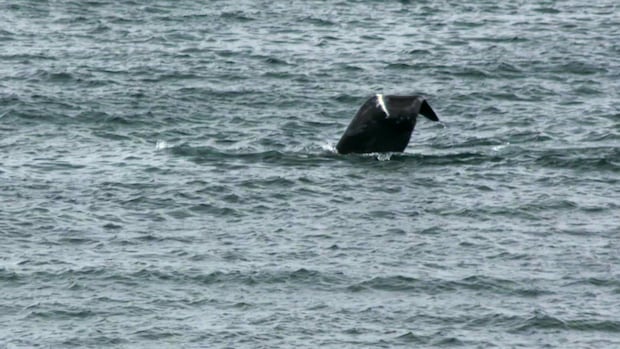
Videographers Heather MacAulay and Chris Murphy captured an exciting moment on September 1 when they encountered a North Atlantic right whale off the Blackhead Cove coast, Newfoundland. Despite being critically endangered, there are encouraging signs that the population may be stabilizing.
This new calf is the offspring of a female named Silt, who is estimated to be at least 38 years old. This marks her sixth calf.
“She’s a very experienced mother,” Warren mentioned. “Her last calf was born in 2022, so this timing aligns well for her to have another this year.”
While right whales can technically have calves every three years, Warren notes that they often take between five and ten years between births.
However, she observes that this interval seems to be decreasing.
“This year, we noticed that the average interval for females was closer to five years, compared to about ten years on average a decade ago between calves.”
How did this calf stay hidden?
These elusive marine creatures typically give birth in the southeastern U.S. during winter and then travel north to New England and Canada for feeding, with scientists diligently monitoring their populations, frequently photographing and cataloguing them based on their distinctive head patterns.
Warren explains that the calves are generally hard to overlook as they are still mastering swimming and can’t hold their breath for extended periods.
“Mothers and their calves usually remain near the surface, making them easier to see,” she noted.
“Thus, for this mother-calf duo to navigate all the way from their birthing area to Canada without being seen by any surveys along the way is quite remarkable and unusual.”
-
North Atlantic right whales at greater risk of collision with boats at night: study
-
Internal DFO memo warns Trump-backed bill threatens right whale survival
The pair was spotted by researchers from the Mingan Island Cetacean Study, a non-profit organization dedicated to marine research in the Côte-Nord region of the province.
“It highlights the vastness of the ocean and how easily these animals can become lost,” remarked Richard Sears, the founder and director of Mingan Island Cetacean Study.
Warren, on her part, expresses hope that this discovery signals a brighter future for North Atlantic right whales.
“That is indeed the hope,” she concluded. “We will discover more in the coming years.”