

As Ivan Teteria walked through the University of Saskatchewan campus during his initial week of classes this autumn, it felt like a testament to the culmination of his hard work.
Three years ago, amid the intensifying conflict in Ukraine, he departed his homeland and arrived in Regina at the age of 15, uncertain about what the future held for him.
In this new environment, he endeavored to recreate a sense of normality through education, friendships, and a future he could envision.
Thanks to a Saskatchewan initiative that enables Ukrainian students who escaped the war to pay the same tuition fees as Canadian students, that future became attainable.
Now a freshman studying political science, Teteria is anxious that this opportunity might soon vanish.
“Individuals who genuinely care about their futures don’t want ‘could bes’ or ‘maybes,'” Teteria remarked. “They require certainty — which, unfortunately, we do not possess.”
The tuition agreement for Ukrainian students in Saskatchewan, jointly financed by the provincial and federal governments, is set to conclude on March 31, 2026.
Established following Russia’s invasion in 2022, this program allows Ukrainian students to enroll in post-secondary institutions in Saskatchewan without incurring international fees, which can be as much as $60,000 annually — and even higher for certain specialized courses.
The provincial government maintains that the agreement has not been terminated — merely that it has not yet been renewed.
However, students report having received communications from their university indicating that winter 2026 will be the final term included under the existing agreement.
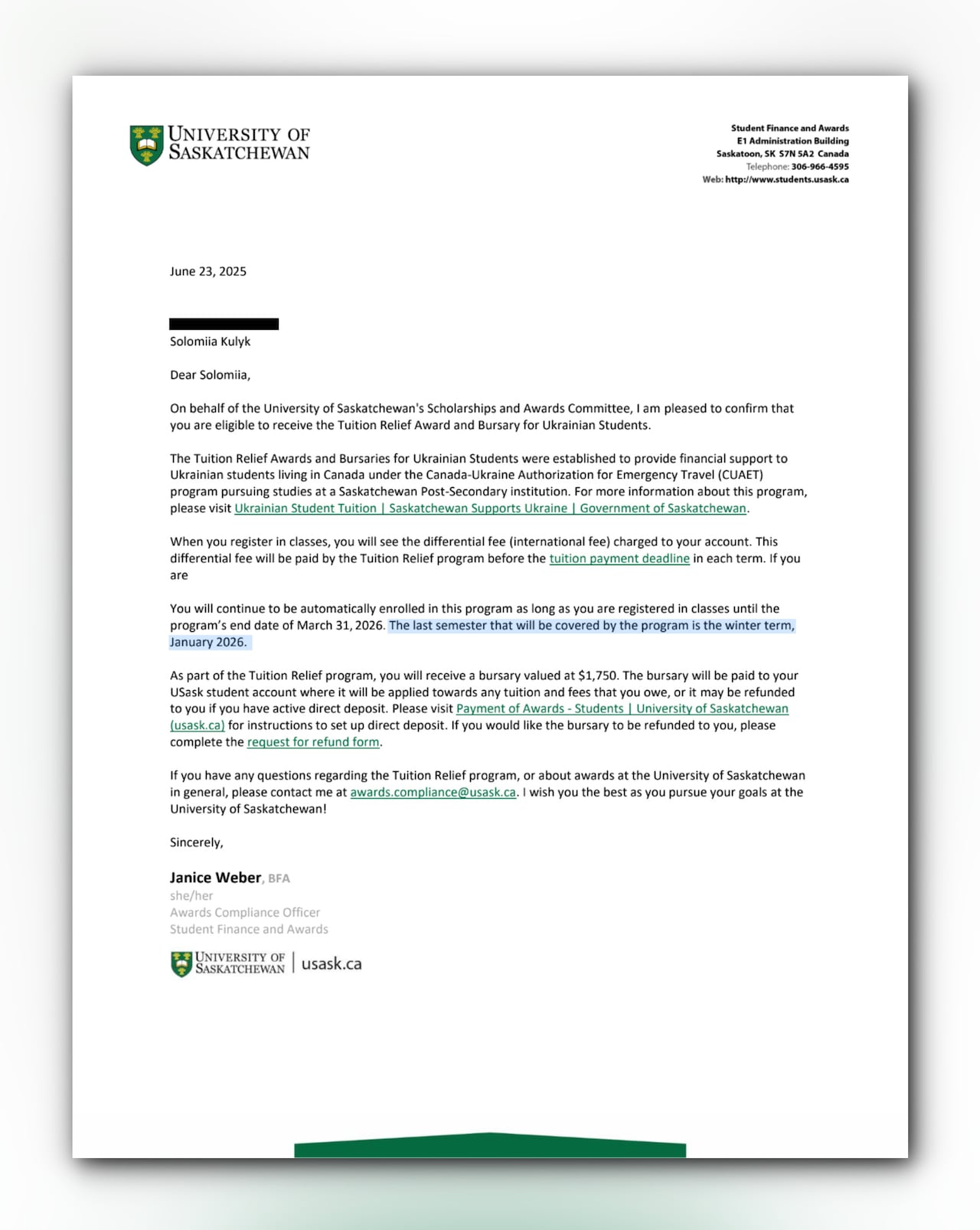
The letter, sent in June, confirms that tuition support for Ukrainian students is only assured until winter 2026. (Submitted by Solomiia Kulyk)
For many, this uncertainty casts a shadow over all other aspects of their lives.
Concerns about escalating costs
Teteria mentions that he is already hearing from Ukrainian high school students who are rethinking their plans for university.
“We have high schoolers not even applying.… They lack the financial resources to manage the exorbitant international tuition fees,” he stated.
“Desperate parents have reached out to me asking, ‘What can we do? How do we solve this problem?'”
The anxiety weighs just as heavily on Solomiia Kulyk, a first-year business student at the University of Saskatchewan.
Having arrived in Regina from Ukraine in 2024, she credits the program as the reason she is able to continue her education.

Solomiia Kulyk on campus. (Submitted by Solomiia Kulyk)
She currently pays approximately $10,000 annually under the domestic fee structure.
Without this support, she asserts that her tuition costs would increase fourfold.
“If we do not obtain our permanent residency by the fall term … we would be unable to continue our studies,” she explained. “We cannot afford that international university fee.”
Both students emphasize that this matter transcends mere financial concerns — it is about the sustainability of the lives they are establishing in Saskatchewan.
“I am determined to build my future in Canada, pursuing a degree and then working to contribute taxes, just like every Canadian [does],” Kulyk expressed.
However, she insists that in order to achieve this, she requires clarity.
Demand for renewal
Earlier this month, Teteria and Kulyk were part of a group of students who attended the Saskatchewan Legislature, observing from the gallery as their circumstances were discussed on the floor.
That same day, Opposition MLAs urged the government to take action.
“Some of these students fled from communities that no longer exist — they came here seeking refuge and aspiring to establish a future in Saskatchewan,” stated Keith Jorgensen, the NDP MLA for Saskatoon Churchill-Wildwood.
“This is not a significant amount of money. This modest investment helps these students to finish their education, secure good jobs, and contribute to Saskatchewan’s economy.”

Ivan Teteria at the Saskatchewan Legislative Building. He feels that until a decision is reached regarding the tuition program, his future is on hold. (Submitted by Ivan Teteria)
The provincial government reports that around 26 students are benefitting from the agreement, with Saskatchewan providing approximately $300,000 annually.
Advanced Education Minister Ken Cheveldayoff states that the agreement remains valid for now and that conversations with the federal government will take place before its expiration.
“We take pride in the existing program, and we will seek to ensure that similar initiatives will be available in the future,” he declared.
Teteria believes that until a resolution is reached, his future feels suspended.
“We can only count on the government and hope they will extend the program without delay,” he stated.