

In its temperature report for May, Berkeley Earth, a prominent non-profit organization focused on climate analysis, predicted that the likelihood of 2026 being the hottest year on record was only 2.5 percent.
Then the development of El Niño began.
By the following month, the probability had increased to 12 percent. By August, it surged to 69 percent. Currently, Berkeley Earth estimates the chance at 96 percent.
Is there a connection between the possibility of 2026 becoming the hottest year ever recorded and this notably strong El Niño?
This El Niño — characterized by a warming of the Pacific Ocean that can lead to a temporary rise in global temperatures — is already the most powerful one since record-keeping began in 1950, surpassing the previous high set during 2015-2016 by a significant margin.
Experts define a strong El Niño as a temperature increase of 2°C above the average. Last week, ocean temperatures in a specific region of the Pacific near the equator, known as “Niño 3.4,” reached 3.5°C above average.
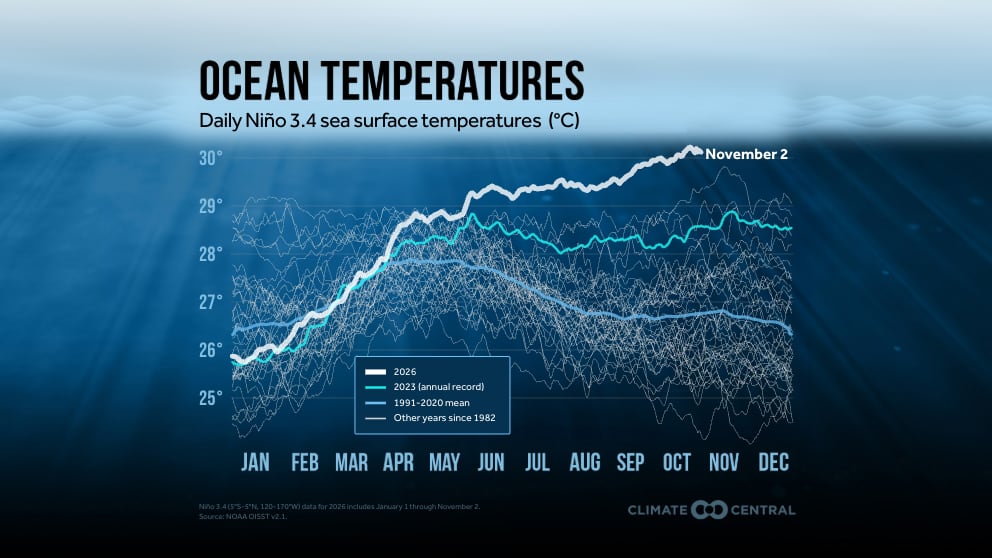
The ocean temperature in the Niño 3.4 region of the Pacific, which is used to gauge El Niño strength, has reached its highest recorded level since 1950. (Climate Central)
Typically, the impact of an El Niño on global temperatures is observed approximately three months following its peak, which is anticipated to occur in November or December. However, models indicate that 2026 is likely to be the warmest year on record, surpassing 2024, or possibly the second-warmest.
“El Niño is definitely contributing to the warmth we are experiencing,” stated Kent Moore, an atmospheric physics professor at the University of Toronto.
In its September update, Berkeley Earth noted, “It continues to be significantly warmer than other months in 2026. September 2026 maintained the trend of months exceeding the 1.5°C threshold that began in July, as the warming effects of El Niño intensified.”
However, the influence is not solely due to El Niño.
Stored Ocean Heat
As Celeste Saulo, Secretary-General of the World Meteorological Organization (WMO), explained at the Global Heat Forum last month, “El Niño does not introduce new heat to the planet. It releases heat that the ocean has been storing beneath the surface.”
This stored heat is a result of climate change, as fossil fuel consumption continues to release additional greenhouse gases into the atmosphere.
-
‘Super’ El Niño didn’t cause this year’s fires and heat waves, but it’s about to take us on a ‘wild ride’
-
El Niño is here, and it’s already looking like it could be ‘mind-blowing’
“The warmth we are witnessing in the oceans… is largely due to the fact that we have been warming the oceans for the past 150 years,” Moore added.
In general, global ocean temperatures are at their highest levels on record, due to the oceans’ exceptional ability to retain excess heat.
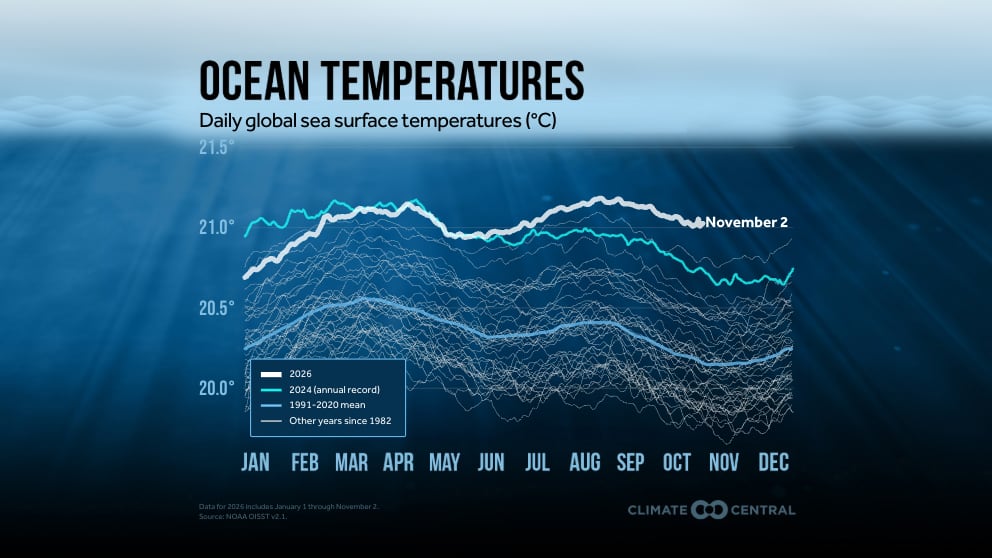
Ocean temperatures have reached the highest levels in recorded history. (Climate Central)
Interestingly, the oceans are also very effective at absorbing CO2, but there are limitations.
“As the ocean warms, its capacity to hold carbon dioxide diminishes,” explained Moore. “This creates a feedback loop. As oceans warm, they become less efficient at absorbing carbon dioxide, resulting in more CO2 remaining in the atmosphere, which in turn causes further warming.”
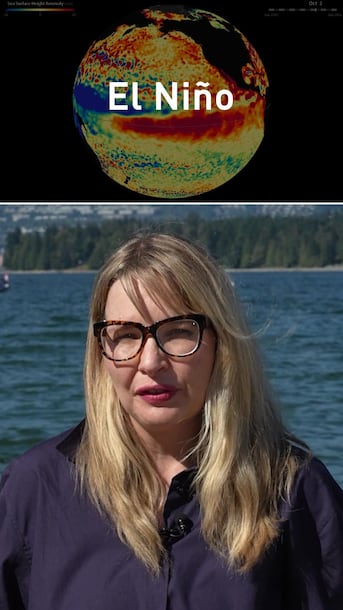
It’s set to be a record-breaking few months of weather, driven by a ‘super’ El Niño. As Johanna Wagstaffe explores, a natural surge of warm ocean water is colliding with a planet hotter than ever before, bringing more extreme heat, floods, and droughts. But this ‘super’ El Niño could also help us prepare for what’s coming.
Thus, while El Niño may contribute to the annual global temperature in 2026, the predominant factor remains the utilization of fossil fuels and the greenhouse gases released into the atmosphere.
“You have the gradual warming of the ocean, followed by El Niño’s influence, which intensifies temperatures for about six months, and then El Niño dissipates, but the warming persists,” Moore noted.
At present, not everyone agrees that 2026 will surpass 2024 as the hottest year recorded.
The U.S. National Centers for Environmental Information assigns only a 0.1 percent probability of it being the warmest year and an 86.9 percent chance of it being the second-warmest.
However, the global temperature for 2027 will be significantly affected by El Niño.
Climate scientist Zeke Hausfather, writing for Carbon Brief, a climate-focused publication, mentioned, “This year’s record-setting El Niño will exert its greatest influence on global temperatures in 2027. Carbon Brief forecasts 2027 to be approximately 1.7°C above pre-industrial levels, with a 96 percent probability of it being the hottest year on record.”