

U.S. President Donald Trump’s recent agreement with China is high on enthusiasm but lacking in specifics, a common theme in his deals. Trump’s meeting with Chinese President Xi Jinping was hailed as exceptional, with Trump giving it a perfect score of 12 out of 10. He announced that China would be purchasing substantial quantities of soybeans and hinted at a potential significant transaction involving oil and gas from Alaska on social media.
Despite Trump’s positive remarks, experts view the agreement between the two leaders more as a temporary truce in the ongoing trade war rather than a definitive resolution. The official framework announced by the U.S. and China primarily involves scaling back some of the previously imposed trade measures and threats.
Dennis Wilder, a professor at Georgetown University, characterized the current situation as a pause in the trade conflict, emphasizing that the war is far from over based on recent developments.
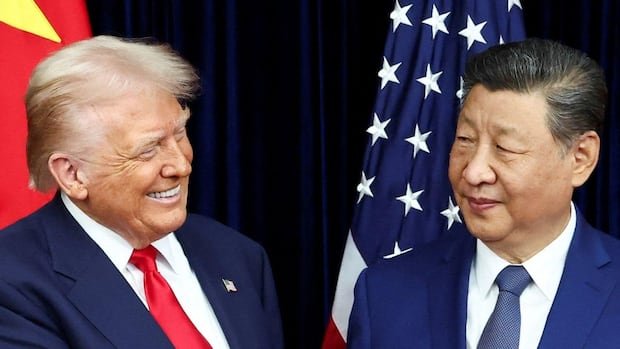
U.S. President Donald Trump has agreed with President Xi Jinping to reduce tariffs on China in exchange for actions against fentanyl trade, soybean purchases, and rare earth exports.
In return for China’s commitment to combat fentanyl production, Trump has agreed to an immediate 10% reduction in tariffs on Chinese exports to the U.S. Trump expressed confidence in China’s efforts to address the issue.
Trump’s decision to decrease tariffs on Chinese goods while simultaneously increasing tariffs on Canadian products reflects his recent trade policy shifts concerning various nations.
Conditional Progress
Wilders notes that the U.S. has been pressuring China to address the fentanyl crisis and is closely monitoring Beijing’s actions. The U.S. is prepared to adjust tariffs further based on China’s response to combatting fentanyl trafficking.
As part of the agreement, China has eased its stance on restricting the export of rare earth minerals and halted the boycott on U.S. soybeans, actions that signify a step back from the retaliatory measures taken during the trade tensions.
The recent developments essentially mark a return to the pre-trade war conditions, with both parties making concessions and adjustments in their trade policies.
Additionally, the U.S. has postponed implementing stricter export controls on advanced semiconductors and suspended port fees on Chinese vessels, further indicating a de-escalation of trade tensions.
According to Joe Mazur, a geopolitics analyst, China’s strategy of measured retaliation has been validated by the recent developments.
- Trump announces new China tariff rates following ‘amazing’ Xi meeting
- ANALYSIS | China’s continued leverage on crucial minerals over the U.S.
The revised terms mean that the average tariff rate on most Chinese imports to the U.S. has now decreased to 47%, a significant reduction from the previously imposed 145% tariff rate.
Craig Kafura, an expert at the Chicago Council