

Kent Hups has long envisioned unearthing a Tyrannosaurus rex bone since his childhood. However, he stumbled upon something far more extraordinary.
In 2025, Hups, who teaches science at Northglenn High School in Colorado, was exploring the North Dakota badlands when he discovered a series of enormous footprints embedded in the rocks.
These footprints are now considered the first confirmed trackway of an adult T. Rex, and their discovery may provide valuable insights into how these legendary dinosaurs traversed the Earth over 66.5 million years ago.
“It’s been quite a ride,” Hups shared with As It Happens host Nil Kӧksal. “It’s surreal. It’s a dream realized.”
Hups co-authored a study validating these findings, which was published in the September issue of the Journal of Vertebrate Paleontology.
Recently, he attended the reveal of the excavated prints at the Denver Museum of Nature & Science.

Kent Hups, a science teacher at Northglenn High School in Colorado, was exploring the badlands of North Dakota in 2005 when he stumbled upon a series of massive footprints in the rocks.
Why are trackways so difficult to locate?
Jordan Mallon, a dinosaur paleobiologist who did not participate in the research, explains that while T. Rex fossils are relatively common, their tracks are surprisingly scarce.
He notes that several single, isolated footprints have been discovered, along with some trackways from other Tyrannosaurid species.
“However, this marks the first authentic T. Rex trackway, which is quite remarkable,” said Mallon, a research scientist at the Canadian Museum of Nature in Ottawa.
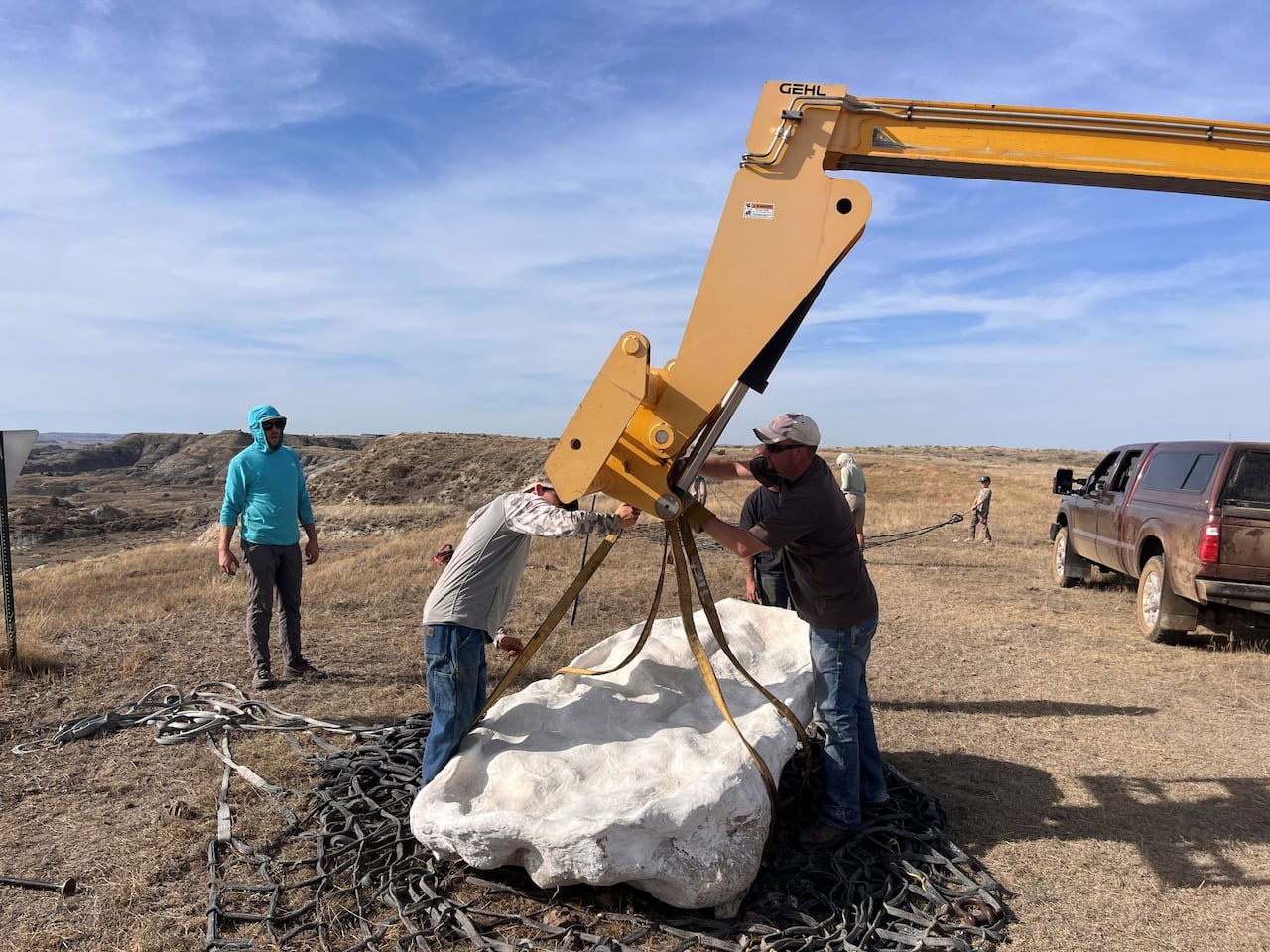
After 3D scanning the track, scientists excavated the prints. (Denver Museum of Nature & Science)
The reason for their rarity remains uncertain, he states. It may be that the conditions suitable for fossilizing bones do not also favor the preservation of tracks. Alternatively, paleontologists searching for bones might overlook what lies directly beneath their feet.
“Paleontologists often specialize in either tracks or bones,” he explained. “I suspect that, at times, we simply walk past them without noticing.”
How researchers identified the footprints as T. Rex
Unlike others, Hups immediately recognized that he had discovered something significant.
While exploring the Hell Creek Formation, a famous geological site from the Cretaceous period, he noticed a reddish-brown hue contrasting against the white and gray surroundings.
“The color initially caught my attention. Then I spotted the three toes,” he recounted. “That’s when I realized I had found a track. I’ve been involved in this for a while, so I’m aware of how uncommon tracks are, but I never imagined I would find one from a T. Rex.”
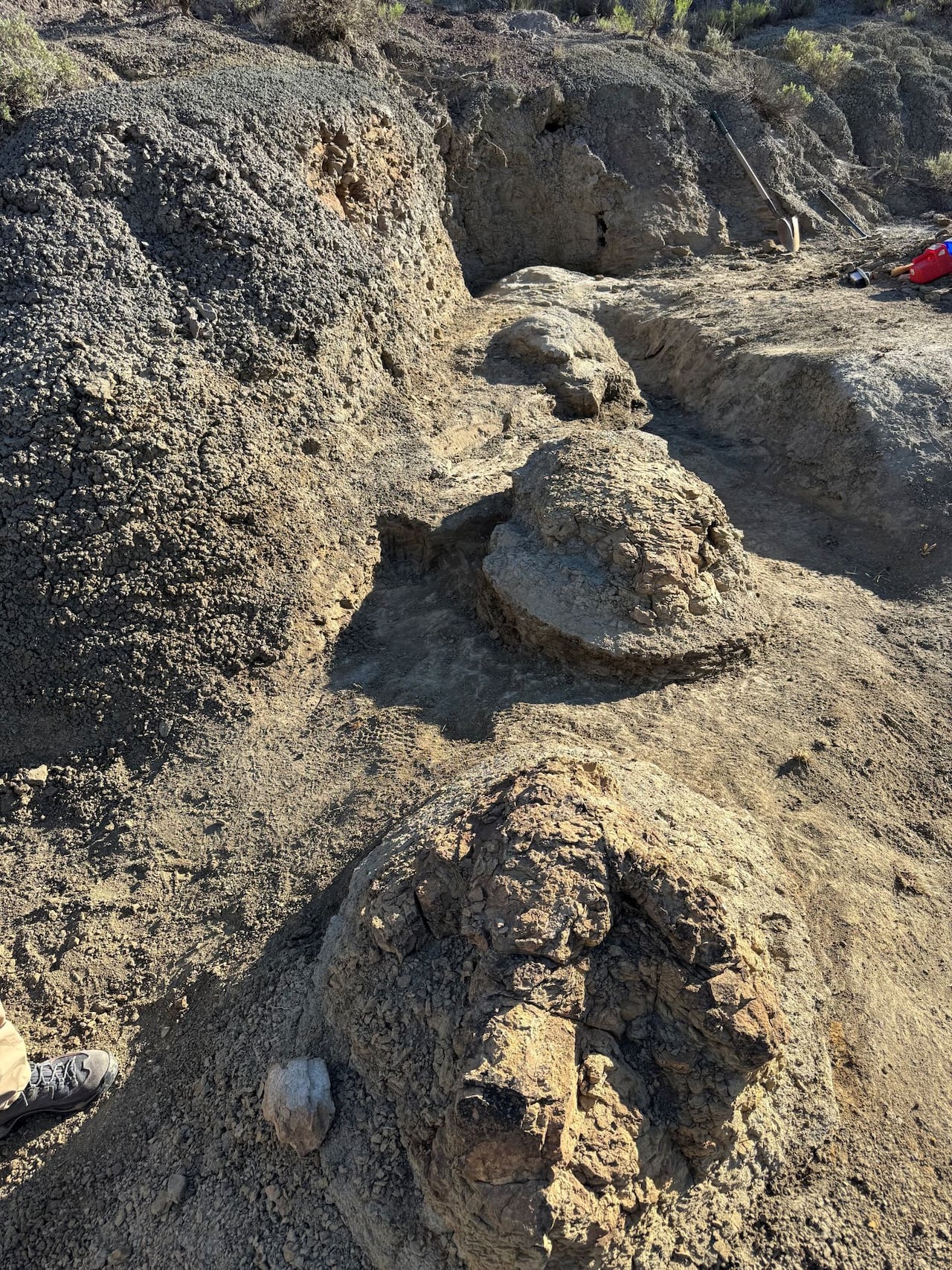
The track within the Hell Creek Formation consists of four three-toed prints. (Tyler Lyson)
The seven-meter trackway comprises four three-toed footprints, each measuring nearly one meter long.
Hups and his co-authors determined that the prints belonged to a T. Rex based on their dimensions, shape, and their location relative to existing T. Rex fossil finds.
“Are we completely certain? No, we don’t have a T. Rex carcass at the end of the trackway. But the evidence is compelling,” Hups stated.
“The dimensions, the stride, the narrowness of the trackway—all of it aligns perfectly. Only a T. Rex could fit that description as it’s the largest creature we know of.”
Why are footprints significant?
Mallon points out that this discovery holds a wealth of information that T. Rex fossils cannot provide, including insights into the creature’s size, movement patterns, habitat, and social behavior.
“Bones represent deceased animals, while tracks reveal what an animal was doing during its lifetime,” he explained.
-
Meet the ‘hell chicken,’ a feisty little dinosaur who feasted on fruit
-
Fossil researchers believe dog-sized raptor may have fed on larger tyrannosaur
He is particularly eager to determine if the tracks can offer insights into the dinosaur’s speed.
“Numerous studies have attempted to model T. Rex biomechanics and analyze their potential speed and running capabilities, often relying on complex engineering principles and mathematical models,” he remarked.
“Ultimately, the tracks will provide the clearest picture of what actually transpired.”
To date, the researchers estimate that the creature responsible for the tracks had a stride of about four meters, moving at a speed of roughly 5.5 to 7.2 kilometers per hour.
The Denver Museum reports that this speed is “comparable to a brisk human walking pace.”
Further discoveries await
Hups believes there is much more to uncover regarding the trackway.
Before the prints were excavated, scientists conducted high-resolution 3D scans of the surface and created a digital reproduction of the track for additional study.
He also expressed optimism that researchers could extract a skin sample from the excavated prints.
“It’s like receiving a Christmas gift,” he stated. “You won’t know what you’ll find until you open it.”
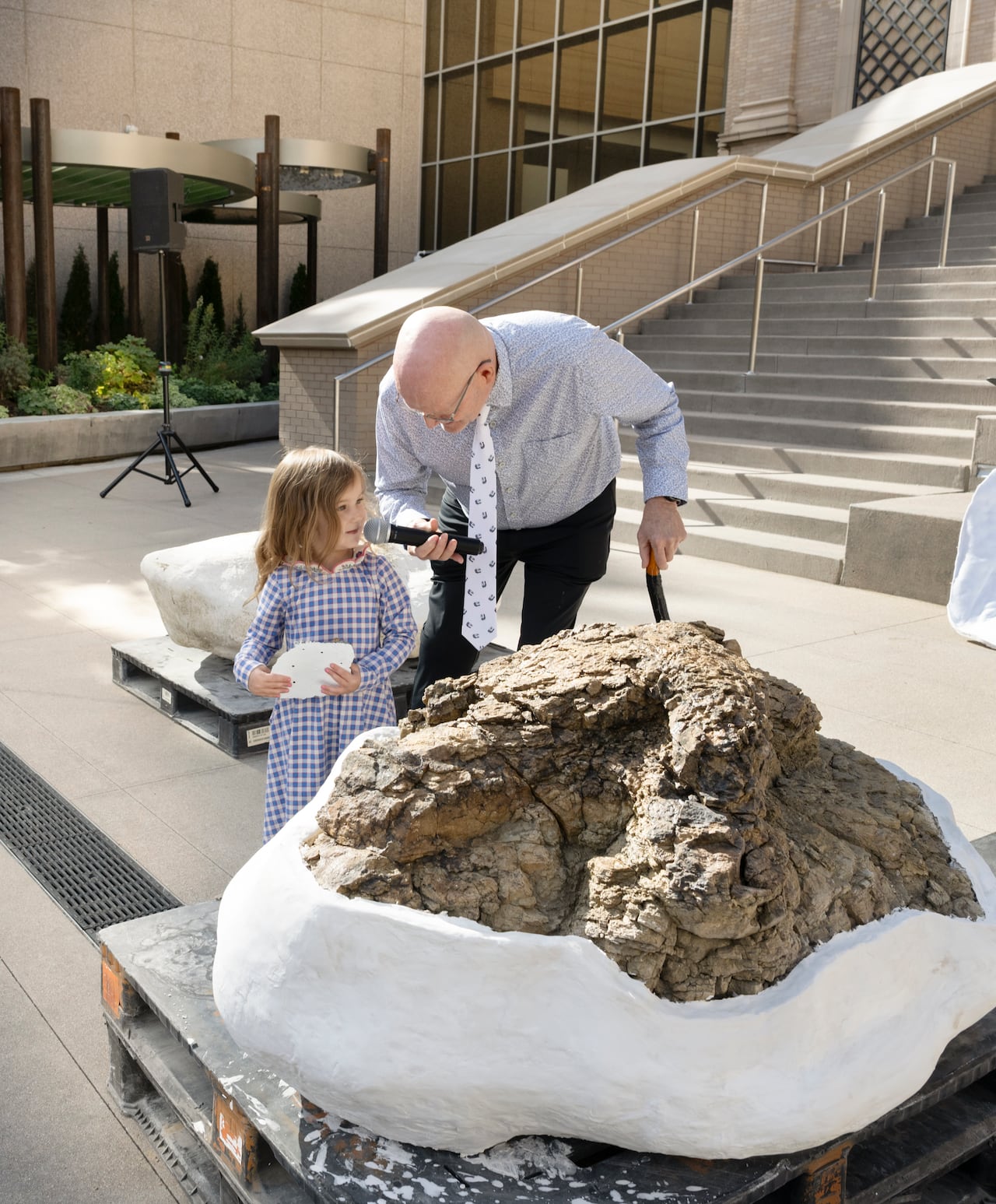
Hups shows a dino footprint to a little girl at the Denver Museum of Nature and Science. (Denver Museum of Nature and Science)
However, one of the four tracks will remain on public display until the end of next year.
During the unveiling, Hups had the opportunity to present the giant footprint to a young girl who was so thrilled that she hugged him in gratitude.
“You could see her wonder and excitement,” he added. “That’s the ultimate reward: having it accessible for everyone to see, while also ensuring it’s preserved for research purposes.”