

Darlene Brander emphasizes that significant efforts are still required to rejuvenate Indigenous languages across Canada, yet there are instances that reaffirm the importance of this endeavor.
“The impact of our efforts is evident when we hear young people conversing in the language,” stated Brander, who serves as the president of the Saskatchewan Indigenous Cultural Centre.
“There’s nothing more delightful than listening to a child, whether they are eight, nine, or twelve years old, speaking the language with both intention and pride.”
The First Nations Language Keepers Gathering, which takes place annually, is being held on Tuesday and Wednesday at Prairieland Park in Saskatoon. Now celebrating its 20th anniversary, the event is organized by the Saskatchewan Indigenous Cultural Centre and unites educators, scholars, and others dedicated to the conservation and revitalization of Indigenous languages.
Brander noted that they are tackling the “erosion of language” prevalent in urban settings and among younger generations, mentioning that the current challenge involves creating and distributing language resources within communities.
According to the 2021 Statistics Canada census, 31,250 First Nations individuals in Saskatchewan reported being able to communicate in an Indigenous language. However, the number of individuals in the province fluent in any Cree dialect saw a decline of 7.4 percent, dropping to 22,730 in 2021 compared to 2016.
“There’s an old saying: use it or lose it,” Brander remarked. “We aim to encourage people to converse in their languages because there’s a unique beauty in doing so… It allows one to embrace a sacred way of life.”
On a national level, the number of Indigenous people capable of conversing in an Indigenous language saw a decrease of around four percent, totaling 237,420 in 2021 compared to 2016, as per Statistics Canada.
Nonetheless, the same census reveals an increasing number of Indigenous individuals opting to learn an Indigenous language. Those learning as a second language represented 27.7 percent of all Indigenous language speakers in Canada, reflecting a rise of 6.7 percent since 2016.
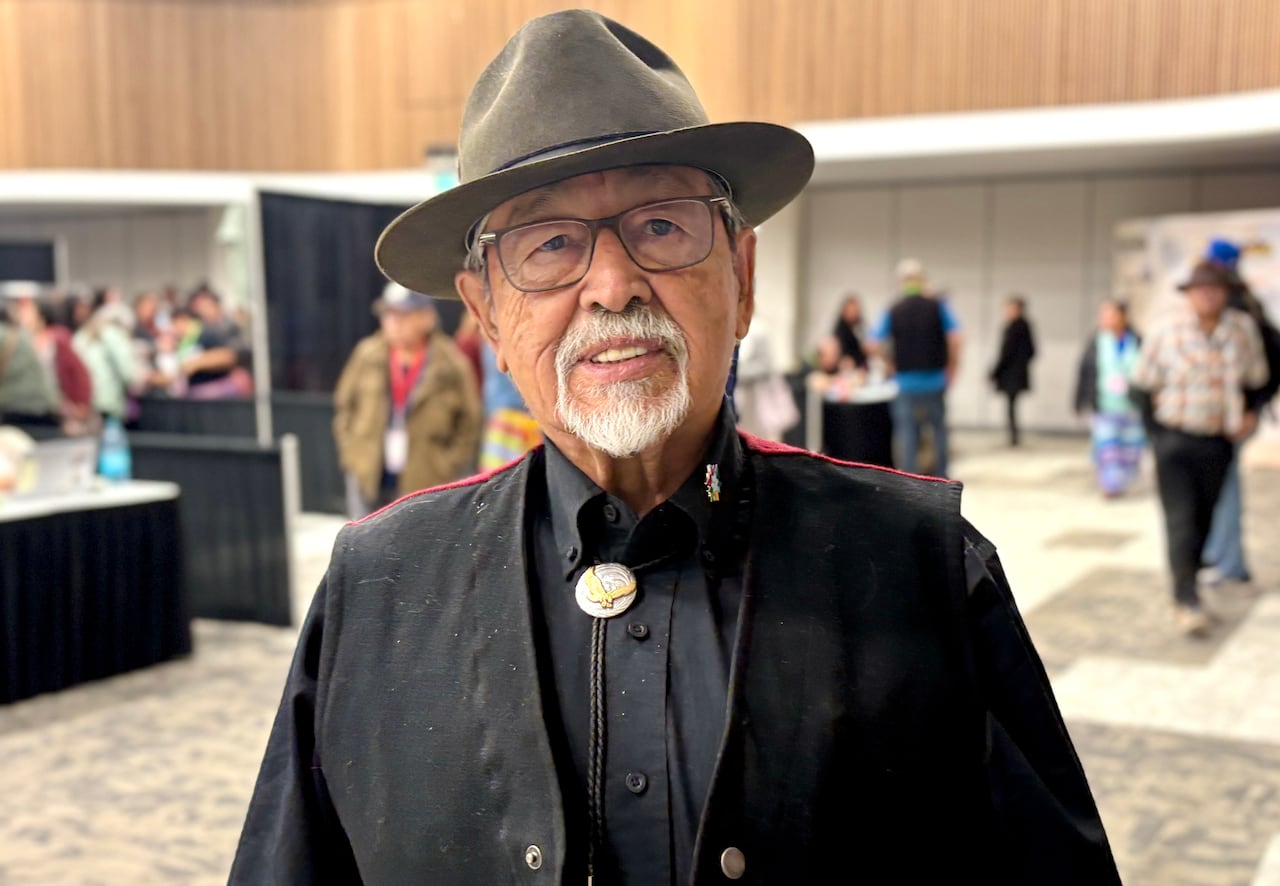
Commissioner Ron Ignace from the federal Office of the Commissioner of Indigenous Languages delivered a keynote address at the 20th annual Language Keepers Gathering in Saskatoon on Tuesday. (Jeremy Warren/CBC)
Ron Ignace, the Commissioner, stated that Canada’s Office of the Commissioner of Indigenous Languages is developing a “road map” that communities can utilize to educate a new generation of speakers.
“Half of the languages in Canada are either critically endangered or endangered, and even those that are sustainable aren’t secure,” Ignace remarked following his keynote speech on Tuesday.
He suggested that Canada should explore language immersion educational models from New Zealand and Hawaii for guidance. He emphasized that language loss transcends mere vocabulary depletion.
“We lose our essence. We lose our spirit, as our language embodies the foundation of our spirit as Indigenous peoples.”