

A spacecraft dedicated to atmospheric research in orbit has identified the strong-smelling gas hydrogen chloride emanating from surface cracks on a colossal ancient volcano on Mars, indicating that the planet may still exhibit volcanic activity.
This finding, significant for the potential of microbial life beneath the surface of Mars, comes from the ExoMars Trace Gas Orbiter, which has recorded this gas—a frequent component of volcanic gases on Earth—in the lower atmosphere around Alba Mons.
Alba Mons, the largest volcano on Mars in terms of surface area, is a broad, gently sloping shield volcano, resembling a warrior’s shield, situated in the northern hemisphere of the planet.
Planetary scientist Daniel Mège from the Space Research Centre of the Polish Academy of Sciences and the University of Bern in Switzerland, who co-authored the research published in the journal Science Advances, stated, “We determined that volcanic seepage is the most probable source of the hydrogen chloride.”
The hydrogen chloride may be resulting from volcanic outgassing through the numerous surface cracks in the Alba Mons area, possibly linked to a subterranean magma chamber.
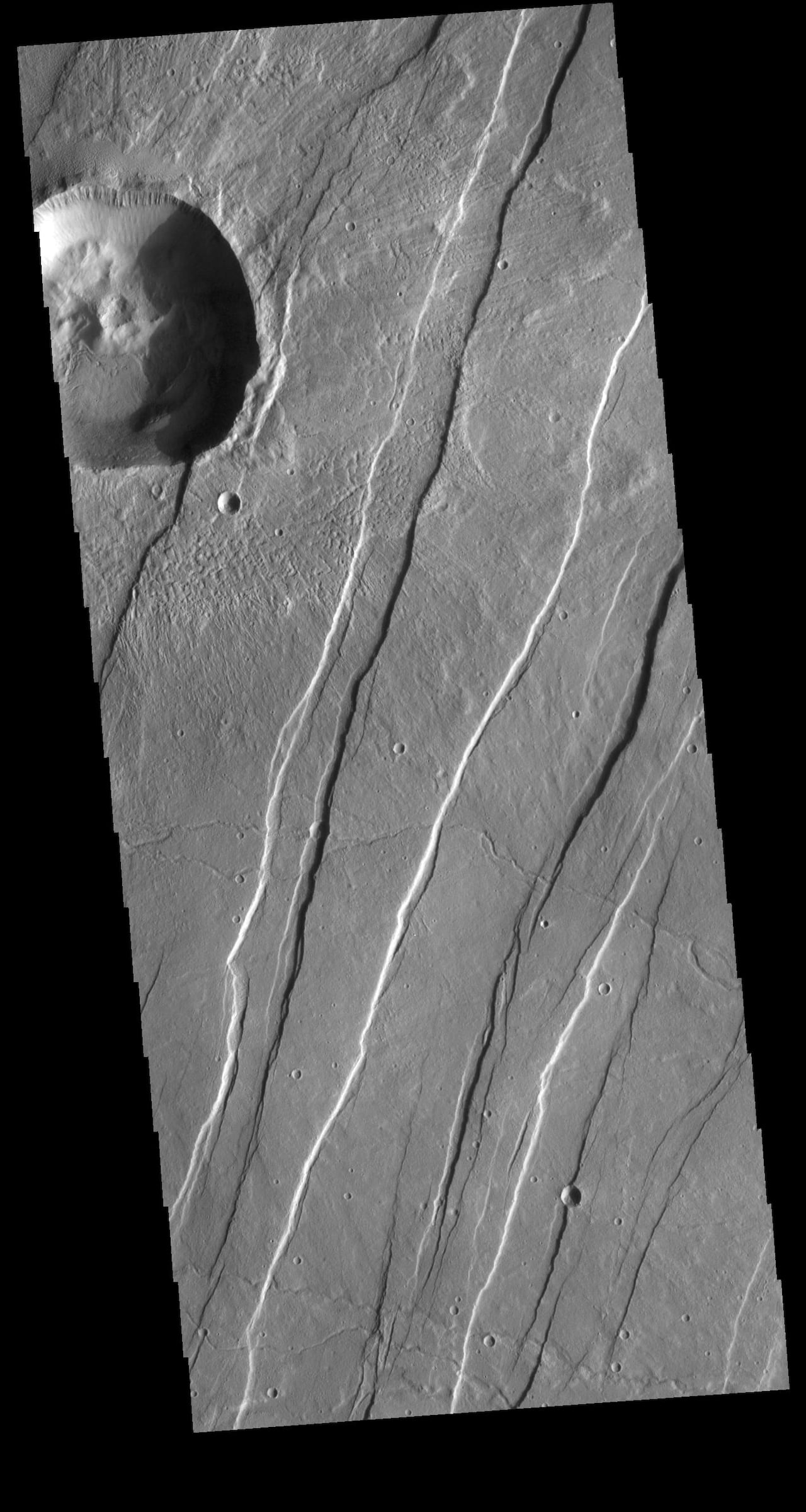
This image depicts a crater and linear fractures on the eastern side of Alba Mons. (NASA/JPL-Caltech/ASU)
“As magma ascends and pressure diminishes, chlorine-bearing compounds dissolve and release hydrogen chloride. Thus, its presence is consistent with magmatic degassing,” explained Alexander Trokhimovskiy, a planetary scientist and co-lead author from the Space Research Institute of the Russian Academy of Sciences.
This suggests that Mars may not be geologically inactive, but rather in a state of relative dormancy.
“This implies that the planet’s interior might still hold enough heat to facilitate magmatic activities, and that trace gases in the atmosphere can help detect and analyze geological processes that are otherwise challenging to observe directly,” Trokhimovskiy added.
An elite club
Only a few celestial bodies in our solar system are confirmed to be volcanically active, including Earth, Venus, and Jupiter’s moon Io.
Mars’s surface has been significantly influenced by ancient volcanic activity, featuring the tallest volcano in the solar system, Olympus Mons. However, the presence of ongoing volcanic activity on Mars has remained uncertain.
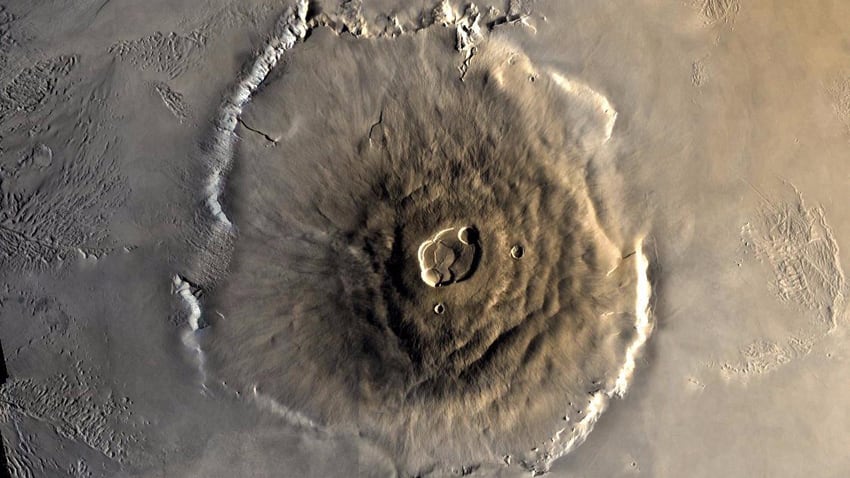
Olympus Mons, captured by Viking 1 in 1978, is the largest volcano and tallest mountain in the solar system. (NASA/Jet Propulsion Laboratory)
Mège remarked, “While there have been reports of volcanism on Mars from a few million years ago, no current magmatic activity had been documented until now.”
Marsquakes detected by NASA’s InSight seismometer also hinted at volcanic activity.
On Earth, volcanic emissions typically contain more sulfur dioxide than hydrogen chloride. However, due to compositional differences between the two planets, hydrogen chloride might be the predominant gas on Mars.
“It has a strong odor, and I would advise against inhaling it, as it is corrosive and can irritate or burn the nasal tissues,” Mège cautioned.
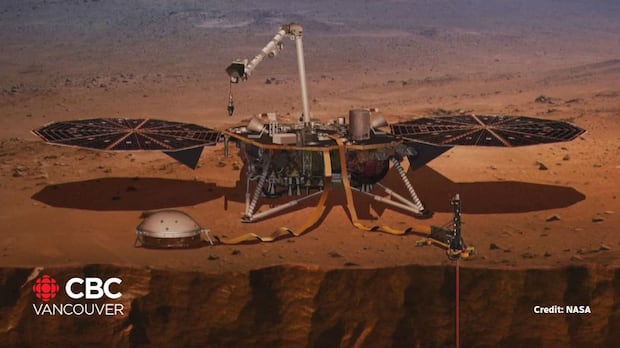
NASA scientists believe there could be an ocean of water deep below the surface of Mars. It’s a discovery that advances the search for life beyond our planet and suggests Mars might have conditions that could sustain microbial life, either in the past or present. Matthew Cimone, head interpreter at the H.R. MacMillan Space Centre in Vancouver, tells us more about this finding.
The orbiter, a joint project between the European Space Agency and Russia’s Roscosmos, was the first to identify hydrogen chloride in the Martian atmosphere and has recorded yearly increases in the gas along the northern slope of Alba Mons during early summer.
Researchers theorize that ice may block the fissures at other times of the year, but the thawing caused by rising temperatures in early summer allows volcanic gases trapped underground to escape into the atmosphere.
-
New evidence finds Mars may have had conditions that could have supported life
-
NASA’s Curiosity rover takes striking image of dawn on Mars
The presence of underground magma supplies raises intriguing questions regarding the possibility of current life on Mars. Active volcanic processes would imply that warm pockets of heat may exist within the planet’s crust.
Mars is already recognized to have water trapped beneath its surface, and it is believed that life on Earth originated billions of years ago in hydrothermal systems.
“As magma ascends through the crust, it can interact with, melt, and heat underground water, forming environments that are protected from the harsh conditions on the surface,” Trokhimovskiy noted.
“Such active hydrothermal systems could provide the necessary energy sources and ideal conditions to support microbial life, making warm subsurface environments one of the most promising areas in the search for life on Mars.”