

What exactly is dark energy? Is a multiverse real? Are there additional forces beyond the four fundamental ones we currently recognize?
These are just a few of the numerous unanswered questions in physics. However, these enigmas — along with the curiosity they ignite — motivate particle physicist Asimina Arvanitaki.
Arvanitaki’s journey as a scientist has led her from studying subatomic particles to exploring the farthest corners of the universe, taking her from her homeland of Greece to the Perimeter Institute for Theoretical Physics in Waterloo, Ontario, where she is currently based. During a Perimeter Institute event on October 7, she engaged in a discussion with Ideas host Nahlah Ayed about her professional journey, the essence of science, the impact of artificial intelligence, and more. Here are excerpts from their dialogue.
Can you share how curiosity has influenced your enthusiasm for science and your research?
One doesn’t pursue a career in science if they aren’t comfortable with feeling confused frequently.
Growing up in Greece, at the conclusion of high school, students are compelled to select a major — a daunting task since it often occurs when they have little understanding of their future aspirations. I was torn between science and engineering. I enjoyed math, physics, and chemistry — all of it. I discovered that I was more intrigued by the questions of “why” things exist the way they do, rather than simply figuring out how to make them function.
This realization led me to physics. Ultimately, I gravitated towards particle physics because it pertains to the fundamental components of matter. While it focuses on the tiniest elements, it also necessitates observing the entire cosmos to comprehend how everything interconnects. Thus, it is a vast field that provides me with considerable intellectual freedom.
Can you recount your earliest expression of scientific curiosity as a young girl?
In elementary school, I learned about the distance of the sun and realized that light travels at a finite speed. I calculated that it takes eight minutes for sunlight to reach us, and I thought, “Oh my goodness! We’ll never see the sun as it currently is!” … It could explode at any moment! We’ve got eight minutes to escape!
What does curiosity look like in the context of scientific inquiry?
It’s something we engage in so instinctively. Every question you pose reflects curiosity. For me, curiosity permeates everything. It’s the desire to understand how this microphone operates. There are countless inquiries. It could be about why we have wood paneling on the walls. Is it for sound quality? Is it for aesthetics? It can encompass anything.
Today, it seems that a significant portion of science funding is directed toward projects with immediate or practical benefits. What risks are associated with overemphasizing this approach compared to curiosity-driven research?
Consider the 19th century. At that time, Rockefeller was the wealthiest individual globally. Suppose he had a vision issue. He’d go to his doctor and say, “Doctor, I want to avoid glasses. Can you find me a less invasive procedure that doesn’t involve inserting anything into my eye?” This would imply he needed laser surgery.
With all his wealth, he would first need to uncover quantum mechanics, grasp the emission of light from atoms, and understand Einstein’s theory of stimulated emission, then wait another 40 years for the first laser to be invented before identifying its applications.
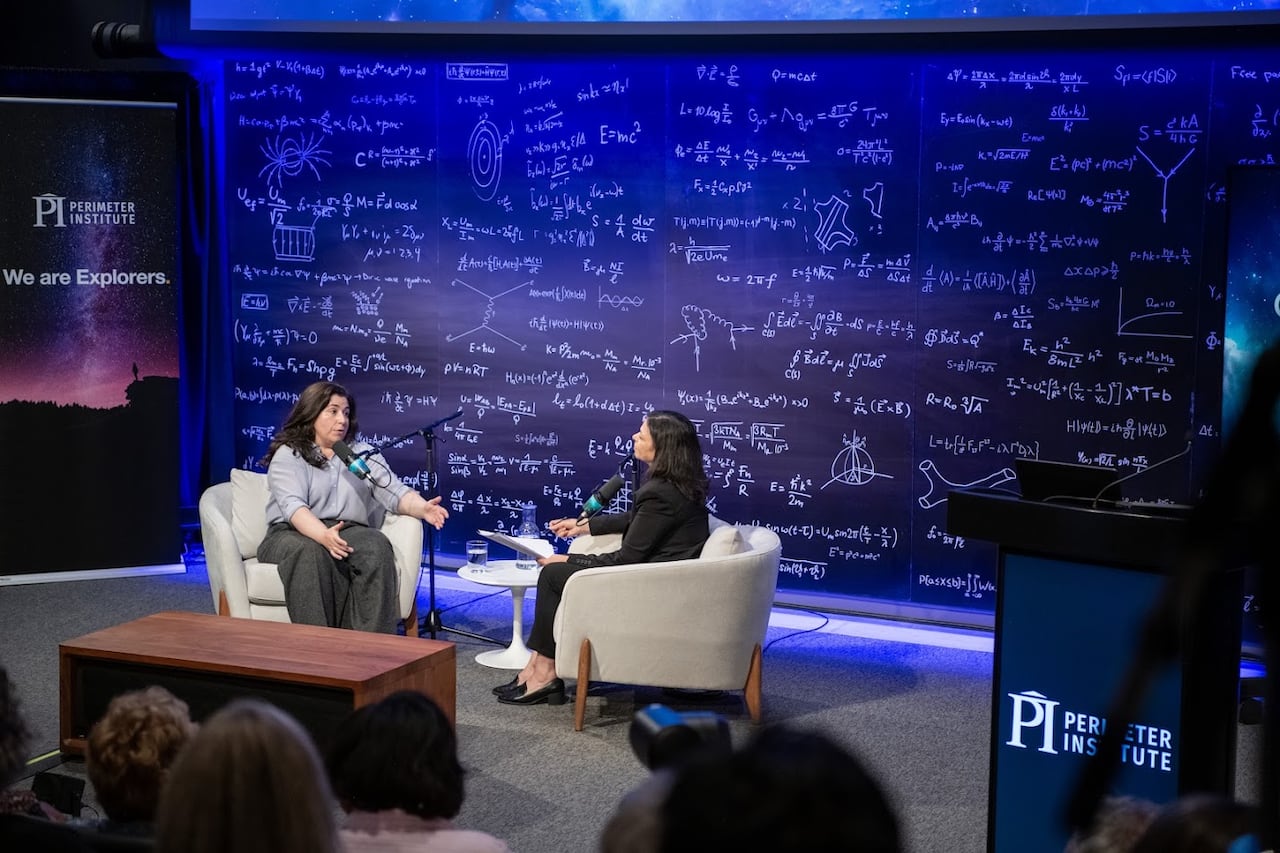
Arvanitaki, left, conversing with Ideas host Nahlah Ayed about her work as a physicist, the significance of curiosity-driven research, and the influence of AI in science. (Gabriela Secara/Perimeter Institute)
If one begins by focusing on the application — the final goal — genuine transformative technologies may be overlooked. Thus, no amount of funding can procure the truly groundbreaking innovations, as they stem from profound understanding. Achieving that understanding often requires navigating through uncertainty.
Do you think there’s a risk that with AI, we might diminish our ability for insight, wonder, and curiosity when we have access to such intelligent tools?
I don’t believe that will happen.
Reflecting on ancient history, one of my forebears, Socrates [laughs], claimed that writing was the worst development for humanity because it negatively impacts the brain. He argued that people should refrain from writing since it leads to forgetfulness and hampers cognitive training.
-
Chemist who transformed energy storage nabs Canada’s top science prize
-
Canadian astronaut Joshua Kutryk conducts his 1st spacewalk
However, when you consider it, writing and language have proven to be the most potent tools for ensuring the intergenerational transfer of knowledge. This has allowed us to build upon the contributions made by our ancestors. That’s how I perceive it.
We are currently undergoing a technological revolution that will alter our methods of operation. We will adapt to these changes. I genuinely believe it will redefine what we consider important. AI excels at computations, which means we will no longer waste time on calculations, something I personally dislike. Nonetheless, the value of ideas will always remain.