

Although the Cold War officially concluded many years ago, recent studies indicate that its effects have persisted in the vegetation of Gatineau Park.
For the past 65 years, researchers have been gathering maple leaves from the extensive park in western Quebec to detect evidence of nuclear radiation.
Research led by Len Wassenaar reveals that these leaves retained traces of radiocarbon from the early Cold War period, with findings published in the journal Nature Scientific Reports and expected to last until 2024.
Wassenaar serves as the executive director at the André E. Lalonde National Facility for Accelerator Mass Spectrometry at the University of Ottawa.
Last week, he appeared on CBC Radio’s Ottawa Morning to discuss his research.
The following interview has been edited for brevity and clarity.

Len Wassenaar indicates that until 2024, the maple leaves in the park contained remnants from nuclear tests conducted over 60 years ago. He is the executive director of the André E. Lalonde National Facility for Accelerator Mass Spectrometry.
Can you explain what you are specifically studying regarding the leaves in Gatineau Park?
The investigation dates back to the 1960s, a time when scientists were increasingly concerned about the global nuclear fallout due to the arms race and hydrogen bomb tests.
In 1961, the Geological Survey of Canada initiated the collection of sugar maple leaves from Gatineau Park. The objective at that time was to assess the impact of atmospheric nuclear weapon testing.
What were the findings from the leaves?
Essentially, the nuclear tests conducted during the 1950s and 60s released significant quantities of radioactive carbon-14 into the atmosphere.
You might recall images of mushroom clouds resulting from these explosions. The carbon interacted and formed carbon dioxide, which rapidly dispersed worldwide.
These nuclear detonations effectively doubled the levels of radiocarbon in the atmosphere, peaking around 1964. The trees absorbed this radiocarbon via CO2 through their foliage.
Nuclear testing largely ceased in 1980, but this identifiable trace has persisted, and we established that it officially concluded in the Ottawa area in May 2024.

Visitors take photos among the autumn colors at Pink Lake in Gatineau Park on Thanksgiving in Gatineau, Que., on Monday, Oct. 12, 2026. (Keito Newman/The Canadian Press)
So, was there no longer any evidence of it by then?
Correct. Two key events occurred.
Firstly, the carbon dioxide that held the bomb radiocarbon was absorbed by vegetation and oceans, effectively removing it from the atmospheric composition.
Secondly, our continued reliance on fossil fuels has contributed to this. Fossil fuels lack radiocarbon, thereby diluting the concentration of bomb-related carbon present in the atmosphere.
These two factors combined have lowered the levels back to what we consider pre-bomb figures. Presently, we are witnessing the ongoing impact of fossil fuel combustion, which is likely to persist in the future.
Is it positive news that these radioactive traces are no longer found in the leaves?
Indeed, it is. This finding highlights the enduring effects of nuclear activities, which can span decades.
It’s important to note that the radiocarbon levels are extremely low, posing no risk to human health. These trace amounts are at parts per trillion, which are negligible.
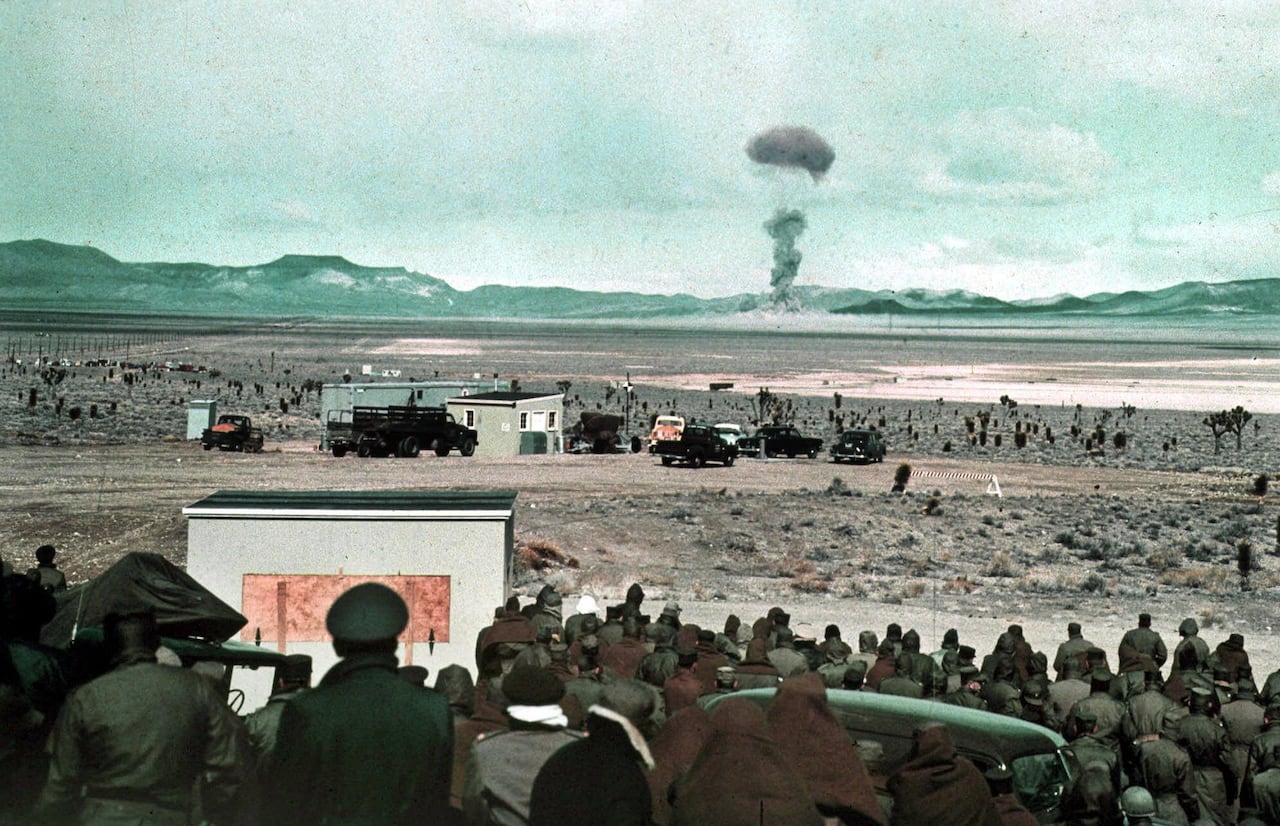
Military personnel observe a mushroom cloud rising from the test explosion known as Met, a 22-kiloton bomb that detonated on April 15, 1955, at the Nevada Test Site, northwest of Las Vegas. (Associated Press)
What broader implications do these findings have?
Firstly, they illustrate the enduring legacy of nuclear testing, which can be detected even 40 to 50 years later.
Additionally, they emphasize the value of long-term research. It took 65 years of consistent monitoring to observe this conclusion.
As we proceed with fossil fuel consumption, if we were to reduce or cease their usage, we could witness a reversal of this trend. This serves as a prime example of how nature can chronicle environmental impacts over extended periods, and it is crucial that we recognize and heed these signs.