

On Wednesday, the International Energy Agency (IEA) announced that global demand for oil and gas is expected to continue increasing until 2050, marking a shift from earlier predictions of a rapid transition to renewable energy in light of U.S. critiques regarding its climate policies.
The energy watchdog based in Paris also suggested in its annual forecast that the global community is likely to fall short of its target to limit temperature increases to approximately 1.5 C (2.7 F) above pre-industrial levels, which is essential to mitigate the most severe impacts of climate change.
In recent years, the IEA has faced pressure from the U.S. to alter its focus towards clean energy initiatives, especially as former President Donald Trump urged U.S. businesses to boost oil and gas production.
Under the Biden administration, the agency projected that global oil demand would peak within this decade and advocated for a cessation of investments in new oil, gas, and coal projects if the aim is to achieve net-zero emissions by 2050.
IEA modifies forecast scenarios
Chris Wright, the former Energy Secretary under Trump, dismissed the IEA’s peak demand projections as “nonsensical.” The IEA is funded by its member nations, with the U.S. being the primary contributor.
In its World Energy Outlook released on Wednesday, the IEA forecasted that under a current policies scenario, oil demand could reach 113 million barrels per day by mid-century, representing an approximate 13 percent increase from consumption levels in 2024.
The agency also estimated that global energy needs will rise by 90 exajoules by 2035, a 15 percent surge from current levels.
This scenario, first introduced by the IEA in 2019 before it shifted towards a narrative aligned with a clean energy transition, is grounded in existing government policies rather than aspirations aimed at achieving climate objectives.
Fatih Birol, head of the IEA, stated during a press call that this scenario was reinstated to represent the varying energy choices governments are making.

Indigenous groups and environmentalists have fought to keep the oil and gas industry out for decades. Now, leaders are reversing protections secured under the previous administration. Caitrin Pilkington reports.
The Organization of the Petroleum Exporting Countries has previously challenged forecasts regarding peak oil demand.
“We hope … we have passed the peak in the misguided notion of ‘peak oil,'” OPEC stated on its website on Wednesday.
This year’s outlook abandoned the pledges scenario as the IEA conveyed that insufficient countries had made new commitments to provide a significant illustration.
In the stated policies scenario, which takes into account proposed but not necessarily enacted policies, oil demand is expected to peak around 2030. The variations in projections stem primarily from differing expectations regarding the adoption of electric vehicles.
The IEA asserts that its scenarios examine a spectrum of potential outcomes based on various assumptions and are not definitive forecasts.
Renewable energy growth alongside fossil fuels
Rachel Cleetus, senior policy director at the Union of Concerned Scientists’ Climate and Energy program, remarked that the IEA report highlights “extraordinary progress” made in renewable energy and energy efficiency worldwide, though she emphasized that this pace is insufficient to surpass fossil fuel growth.
“Thus, there is no pathway to achieving our climate objectives without a rapid and equitable phase-out of fossil fuels to accompany this remarkable renewable growth,” she noted.
Conversely, Wilmar Suarez, an energy analyst with the think tank Ember, argued that the IEA is underestimating the scale and speed of renewable energy development in its findings, particularly in developing regions.
“Costs are decreasing,” he stated, “which grants emerging markets access to technology… to utilize electricity more cleanly within their areas.”
Soaring LNG capacity
The IEA report also highlighted a significant increase in final investment decisions for new liquefied natural gas (LNG) projects in 2025. Approximately 300 billion cubic meters of new annual LNG export capacity is expected to commence by 2030, representing a 50 percent rise in available supply.
According to the current policies scenario, the global LNG market is projected to expand from around 560 billion cubic meters in 2024 to 880 billion cubic meters in 2035, and further to 1,020 billion cubic meters by 2050, driven by increased power sector demand spurred by data centers and AI advancements.
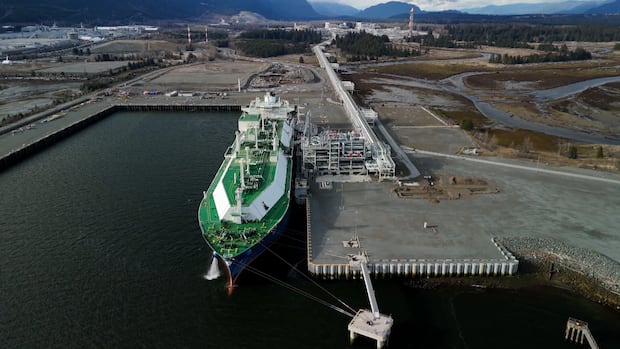
Expanding Canada’s only liquified natural gas terminal is at the top of Prime Minister Mark Carney’s list of projects his government would help fast track, but as CBC’s Lyndsay Duncombe explains, several key factors stand in the way.
The report indicated that global investment in data centers is projected to reach $580 billion by 2025, highlighting that if this target is met, it would exceed the $540 billion spent annually worldwide on oil supply.
Additionally, the report outlines a scenario that illustrates a route to achieving net-zero global energy emissions by 2050.
At the 2015 Paris climate talks, more than 190 nations committed to efforts aimed at preventing the world from warming beyond 1.5 C.
However, the report indicates that all scenarios predict the world will experience greater warming than this threshold.