

Indigenous Services Minister Mandy Gull-Masty has stated that the Assembly of First Nations has conveyed a powerful message to her administration regarding the need to abolish the second-generation cut-off in the Indian Act. However, she emphasized that her government will not implement this change without extensive consultations with community leaders.
During a special assembly in Ottawa last week, First Nations chiefs voted to endorse Senate amendments to a government bill aimed at broadening eligibility under the Indian Act by removing the second-generation cut-off. This clause currently prevents individuals from registering for status if both their parent and grandparent lack status.
The resolution, which was unanimously accepted at the Assembly of First Nations gathering in Ottawa, also urges the federal government to allocate additional funding to help communities absorb new members.
The AFN serves as an advocacy organization for 600 First Nations chiefs who gather twice a year to deliberate on issues and pass resolutions guiding the executive committee on lobbying efforts directed at the government.
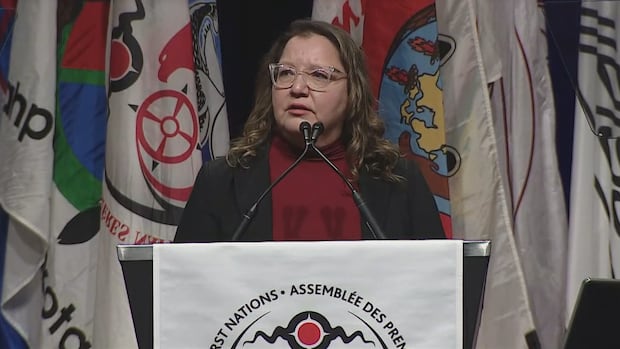
Assembly of First Nations National Chief Cindy Woodhouse Nepinak addressed a national meeting in Ottawa on Tuesday, stating that the Liberal government’s fall budget could serve as an opportunity to rebuild trust with First Nations after the government had previously ‘rammed through’ significant legislative projects ‘without consultation.’
The AFN is not a rights-holding entity, and while every chief can attend its meetings, some opt not to participate.
For instance, chiefs in Alberta lack a regional representative on the AFN executive committee, although some from the province do engage in AFN-organized activities.
Liberal MP Jaime Battiste, a Mi’kmaw, previously indicated to The Canadian Press that the government must secure support for any changes to the Indian Act from First Nations via the AFN.
Previous AFN assemblies have also passed resolutions advocating for the elimination of the second-generation cut-off.
Gull-Masty, who engaged with chiefs about the second-generation cut-off the day prior to the vote, mentioned to The Canadian Press on Monday that she has a “legal and constitutional obligation” to consult with chiefs and seek their input on alternatives.

Liberal MP Jaime Battiste previously told The Canadian Press the government would need to get buy-in for Indian Act changes from First Nations through the AFN. (Justin Tang/The Canadian Press)
She expressed that she is “still contemplating” the resolution and the discussions she had with chiefs during the three-day AFN meeting.
Bill S-2, which was introduced in the Senate with the backing of the Liberal government, aims to address gender disparities in the Indian Act and would enable approximately 6,000 individuals to qualify for Indian status.
The Senate made revisions to the legislation to abolish the second-generation cut-off, a stipulation that originated from an amendment to the Indian Act in 1985.
Communities face risks due to cut-off, chiefs warn
Some chiefs have voiced concerns that this cut-off could result in their communities lacking federally recognized members in the subsequent generation, effectively stripping them of their rights as a distinct group.
Chief Wilfred King of Gull Bay First Nation, while advocating for the resolution at the AFN assembly, stated that those who would gain eligibility for status once the second-generation cut-off is lifted are already known within their communities.
“We are referring to individuals who are connected to our community. We are talking about individuals who are directly related to members of chief and council, as well as community members,” he remarked.
“These are not unfamiliar faces. These are our people.”
-
Delayed introduction of First Nations clean water bill ‘unacceptable,’ say chiefs
-
Ottawa, First Nations prepare competing child welfare reform plans
-
Indigenous cultural belongings return to Canada from Vatican after long journey
Gull-Masty expressed her belief that the Senate should not modify the legislation without the involvement of the House of Commons and prior consultations with First Nations.
She mentioned that as a Cree woman overseeing legislation that gives the federal government authority over the lives of First Nations peoples, she is aware of the concerns chiefs have regarding the current law.
Senator Paul Prosper, who played a role in amending the legislation in the Senate’s Indigenous Peoples committee, informed the chiefs that the majority of witnesses his colleagues spoke to were nearly unanimous in advocating for the repeal of the second-generation cut-off.
He noted that some politicians perceive changes to status eligibility primarily as a financial issue, given that per-capita funding for First Nations would need to be increased if more members are recognized by the federal government.